
Free North Carolina Power of Attorney Revocation Form | PDF & Word
In the state of North Carolina, the authority granted through a Power of Attorney (POA) is not necessarily permanent. Whether your circumstances have changed, your trust in an agent has diminished, or the specific task for which the POA was created has been completed, you have the legal right to terminate that authority. The North Carolina Power of Attorney Revocation Form is the formal legal instrument used to officially cancel a previously executed proxy, ensuring that third parties and financial institutions are no longer authorized to recognize the agent’s power.
59 Ratings
454 Downloads
Fully Editable Files
Print-Ready PDF
Industry Standard Templates
Understanding the North Carolina Power of Attorney Revocation
Under the North Carolina Uniform Power of Attorney Act (Chapter 32C of the General Statutes), a principal who has the mental capacity to do so may revoke a power of attorney at any time. Revocation is a critical step in estate planning and asset protection. Simply telling someone that they are no longer your agent is often legally insufficient; a written, notarized revocation provides the definitive “paper trail” required by banks, healthcare providers, and the Register of Deeds to cease the agent’s access to your affairs.
This document serves as a clear declaration that the prior “grant of authority” is null and void. Without a formal revocation, an agent might continue to act on your behalf, potentially leading to unauthorized transactions or medical decisions that no longer align with your current wishes.
[dflip id=”26381″][/dflip]
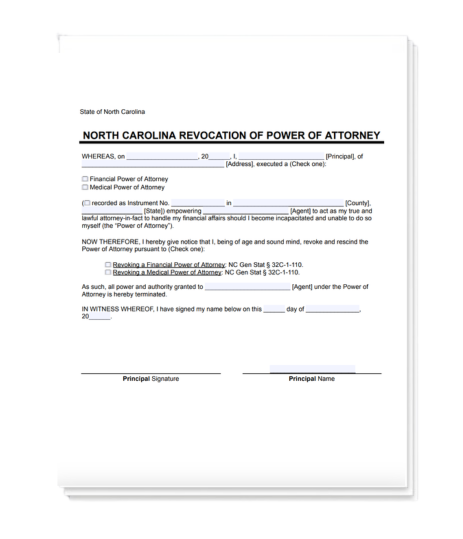
Key Features of a Valid Revocation Form
To be effective in North Carolina, the revocation document must contain specific elements to ensure it is recognized by legal and financial entities. Our professional template includes:
- Clear Identification: Precise fields for the Principal’s full legal name and address.
- Reference to the Original POA: Sections to list the date the original Power of Attorney was signed and, if applicable, the book and page number where it was recorded.
- Specific Agent Details: Clear identification of the agent (and any successor agents) whose authority is being terminated.
- Declaration of Intent: Standardized legal language explicitly revoking all powers granted in the previous document.
- Notary Acknowledgment: A formal section for a Notary Public to verify the principal’s signature, which is a requirement for recording in North Carolina.
How to Legally Revoke a Power of Attorney in NC
The process of revocation involves more than just signing a new piece of paper. To ensure the revocation is ironclad and legally enforceable throughout North Carolina, follow these essential steps:
1. Execute the Written Revocation
Complete the North Carolina Power of Attorney Revocation Form while in the presence of a Notary Public. Your signature must be voluntary and made while you are of sound mind (competent). In North Carolina, a notarized signature is standard practice to prevent fraud and ensure financial institutions accept the document.
2. Record the Document (If Necessary)
If your original Power of Attorney was recorded in the County Register of Deeds (which is common for POAs involving real estate transactions), you must also record the Revocation Form in the same county. This provides public notice that the agent’s authority over real property has ended.
3. Provide Actual Notice to the Agent
You must provide a copy of the signed and notarized revocation to the agent whose power is being revoked. It is highly recommended to send this via certified mail with a return receipt requested. This prevents the agent from claiming they “didn’t know” the POA was cancelled.
4. Notify Third Parties
This is the most crucial step. You must send a copy of the revocation to every bank, brokerage, hospital, and insurance company where the agent may have used the original POA. Under NC General Statute § 32C-1-119, third parties are generally protected from liability until they receive “actual notice” of the revocation.
Why Using a Specific NC Template Matters
North Carolina updated its Power of Attorney laws significantly in recent years. Using a generic, “one-size-fits-all” revocation form from an unreliable source might lead to rejection by local institutions. Our template is specifically tailored to the nuances of North Carolina law, ensuring that the terminology used aligns with state statutes, thereby minimizing the risk of legal complications during the transition of authority.
Frequently Asked Questions (FAQ)
Does a new Power of Attorney automatically revoke the old one?
In North Carolina, a new POA does not automatically revoke a previous one unless the new document specifically states that all prior Powers of Attorney are revoked. Using a separate Revocation Form is the safest way to avoid confusion.
Can I revoke a Power of Attorney if I am not in North Carolina?
Yes, as long as the original POA was governed by North Carolina law, you can execute a revocation from another state, provided it is notarized according to the laws of the state where you are signing.
What happens if the agent refuses to stop acting?
Once they have received notice of revocation, any further action they take is unauthorized and potentially fraudulent. You may need to seek an injunction or legal counsel if the agent continues to interfere with your affairs.
Do I need a witness to sign the revocation?
While North Carolina law emphasizes notarization for the Power of Attorney Act, having a witness can provide an extra layer of security, though it is not strictly required if the document is notarized.
Is there a fee to revoke a Power of Attorney?
The form itself is free here, but if you choose to record the document with the Register of Deeds, the county will charge a standard recording fee (usually per page).
Related Legal Resources
- Arizona Prehospital Medical Care Directive Form
- Illinois Advance Directive Form
- North Carolina Statutory Short Form Power of Attorney
- North Carolina Healthcare Proxy Guidelines
Disclaimer
The templates available on laasrihafid.com are provided for general informational and educational purposes only and do not constitute legal advice. They are not intended to comply with any specific legal, regulatory, or jurisdictional requirements and should not be interpreted as such.
All templates are offered as general examples and are not a substitute for professional legal consultation. You should not rely on them for any specific legal matter or situation. Users are strongly encouraged to seek advice from a qualified and licensed attorney in their respective jurisdiction before using, modifying, or relying on any template provided on this website.
All templates and materials on laasrihafid.com are provided on an “as is,” “as available,” and “with all faults” basis. The website owner makes no warranties or representations of any kind, whether express or implied, including but not limited to warranties of accuracy, completeness, reliability, merchantability, fitness for a particular purpose, or non-infringement.
laasrihafid.com does not guarantee the accuracy, completeness, or expected results of any templates or related materials, nor does it assume any liability for their use. Any reliance on the content of this website is strictly at your own risk.